
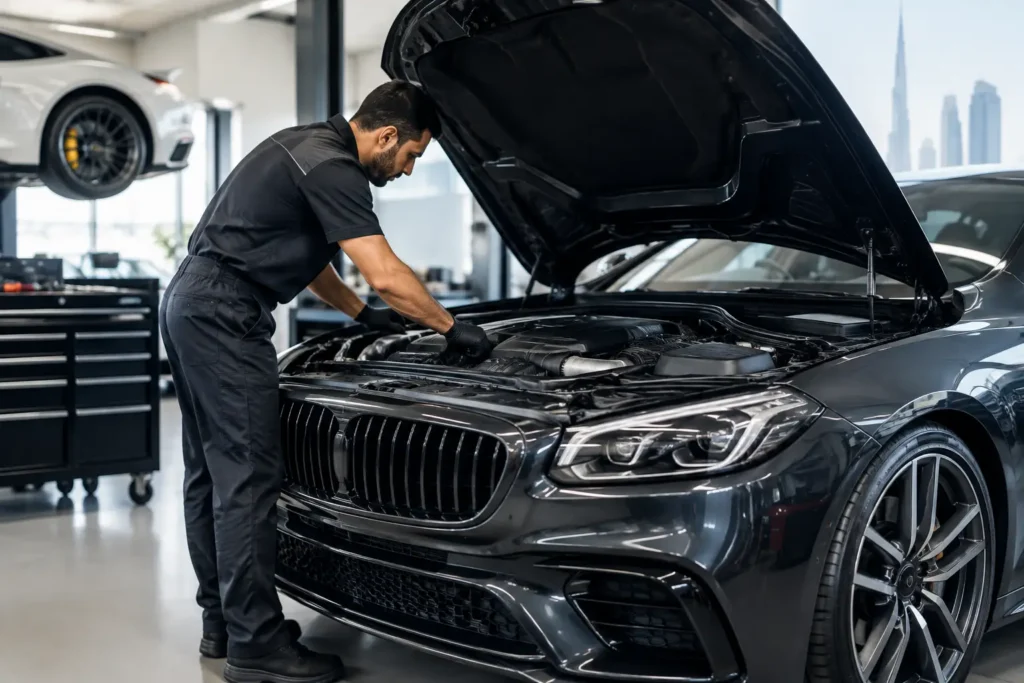
A warning light on a premium car is rarely just a warning light. On a modern BMW, Porsche, Mercedes-Benz, Audi, or Range Rover, one fault can affect several control modules, driving systems, and safety features at once. That is why car repair Dubai should begin with accurate diagnosis, not a quick assumption or a parts-swapping exercise.
Dubai’s heat, stop-start traffic, fine dust, and high-speed driving place particular demands on sophisticated vehicles. Luxury and performance cars are engineered to tight tolerances, and their maintenance needs are just as precise. Choosing the right independent workshop can protect the vehicle’s reliability, resale value, and the driving experience that made you choose it in the first place.
Why premium vehicles need specialist car repair in Dubai
A premium vehicle is not simply a standard car with more features. It often has multiple interconnected electronic systems, turbocharged or high-output engines, air suspension, adaptive dampers, dual-clutch or advanced automatic transmissions, and manufacturer-specific service procedures. A repair that appears straightforward can require specialist equipment, technical data, software adaptations, or component calibration.
Take brake work as an example. Replacing pads and rotors on a high-performance vehicle involves more than fitting new parts. The workshop must select components suited to the exact model and braking system, inspect sensors and calipers, measure wear correctly, and reset the electronic service indicator where required. On cars with electronic parking brakes or brake-by-wire systems, incorrect procedures can create new faults.
The same principle applies to routine oil service. Approved oil specifications, filter quality, correct fill levels, and service resets all matter. Using a lubricant that is close enough on paper but not approved for the engine can compromise protection, particularly in Dubai’s high ambient temperatures. Genuine OEM parts and approved fluids are not a luxury add-on. They are part of maintaining the systems as their engineers intended.
Start with diagnosis, not guesswork
The most expensive repair is often the one performed before the real problem has been identified. Modern cars can store fault codes for an issue that is current, intermittent, or caused by a separate component. Reading a code is only the first step. A capable technician must interpret live data, check wiring and connectors, test related systems, and understand the known failure patterns of that particular platform.
For instance, an engine warning light could relate to an ignition coil, injector, vacuum leak, sensor reading, fuel pressure issue, turbocharger control fault, or software-related concern. Replacing a sensor because a generic scanner named it may not resolve the cause. The correct approach is to verify the fault through methodical testing.
This matters even more with electrical and computer-system issues. Intermittent battery drain, infotainment failures, warning messages, parking-sensor problems, or communication errors between modules can be time-consuming to trace. A specialist workshop with brand-capable diagnostic equipment can access deeper manufacturer-level information and carry out the required coding, adaptations, and calibrations after repair.
Clear communication should follow the inspection
Technical depth should not mean confusing explanations. Before work begins, you should receive a clear description of the concern, the findings, the recommended repair, and the expected cost. If further investigation is needed, that should be explained before additional labor is authorized.
A transparent estimate also separates essential work from items that can be monitored. A worn brake pad needs timely attention. A minor fluid seepage may need repair now or may be suitable for observation depending on its location, severity, and the vehicle’s use. Honest advice gives the owner enough information to decide without pressure.
Repairs that cannot be treated as routine
Some jobs carry higher consequences if they are delayed or handled without the right experience. Engine overheating, transmission hesitation, heavy steering, brake vibration, and air-suspension warnings deserve prompt assessment, especially on vehicles with complex mechanical and electronic systems.
Engine repairs can range from a simple oil leak or cooling-system component to timing concerns, turbocharger faults, internal wear, or poor compression. The right repair depends on evidence, not alarm. A workshop should inspect the vehicle thoroughly, identify whether a targeted repair is viable, and explain when a more extensive rebuild or replacement is genuinely justified.
Transmission issues require similar restraint. Harsh shifts, delayed engagement, slipping, or a gearbox warning may result from fluid condition, a valve-body concern, an electrical issue, software adaptation, clutch wear, or internal damage. Recommending a transmission replacement without proper diagnosis is not precision repair. Equally, ignoring early symptoms can turn a manageable repair into a major one.
Air conditioning is another system that deserves more attention in Dubai than many owners realize. Weak cooling can be caused by low refrigerant, a compressor issue, a leaking seal, a blocked condenser, cabin-filter restriction, blend-door fault, or electrical control problem. Simply adding refrigerant without leak testing may restore cooling briefly while allowing the underlying problem to continue.
Maintenance is the best repair strategy
Scheduled maintenance is the foundation of dependable ownership. Following the dashboard service reminder alone may not be enough for every car, particularly one driven in hot weather, short city journeys, or demanding conditions. Service intervals should consider the manufacturer schedule, mileage, age, vehicle condition, and how the car is actually used.
Oil and filter changes, brake-fluid service, coolant checks, battery testing, tire inspections, and air-filter replacement all contribute to reliability. On performance and turbocharged engines, regular oil care is especially important because heat and contamination place additional strain on lubricants and internal components.
For owners who drive less frequently, time still matters. Fluids age, batteries discharge, tires can develop flat spots, and seals may deteriorate. A car that spends long periods parked in a garage can need as much attention as one that covers high mileage. A practical inspection before the summer season or before a long road trip can prevent an avoidable breakdown.
Performance upgrades need the same discipline
Tuning can make a well-engineered car more responsive, more powerful, and more enjoyable. It should never be treated as a shortcut. A Stage 1 or Stage 2 upgrade must account for the condition of the engine, transmission, cooling system, brakes, tires, and supporting hardware.
The best starting point is a health check. If a vehicle already has boost leaks, worn ignition components, cooling concerns, or stored fault codes, adding power first is the wrong order. Safe tuning begins with a sound mechanical baseline, suitable software, and realistic expectations about fuel quality, heat management, service requirements, and component wear.
How to choose a workshop for your vehicle
Look beyond a low initial quote. A quality workshop should be willing to explain its process, show you the condition of relevant components where practical, and use parts that match the vehicle’s requirements. It should also have technicians who regularly work on your make, rather than treating every European or exotic car as broadly the same.
Ask whether the workshop has the diagnostic capability to perform coding and calibration where necessary, whether it uses OEM-quality parts and approved lubricants, and how it handles unexpected findings during a repair. Progress updates matter as well. Complex diagnosis can take time, but you should not be left wondering what is happening to your car.
AM Motor Works approaches premium vehicle care with this balance of technical discipline and direct communication. From BMW and MINI diagnostics to Porsche maintenance, Mercedes-Benz repairs, and high-performance projects, the aim is to identify the actual issue, recommend the appropriate work, and keep the owner informed throughout the process.
A trusted workshop relationship is built before an emergency occurs. Book an inspection when the first warning appears, when a new noise develops, or when the car simply no longer feels as precise as it should. Early, expert attention is usually the most sensible way to keep a sophisticated vehicle performing at its best.