
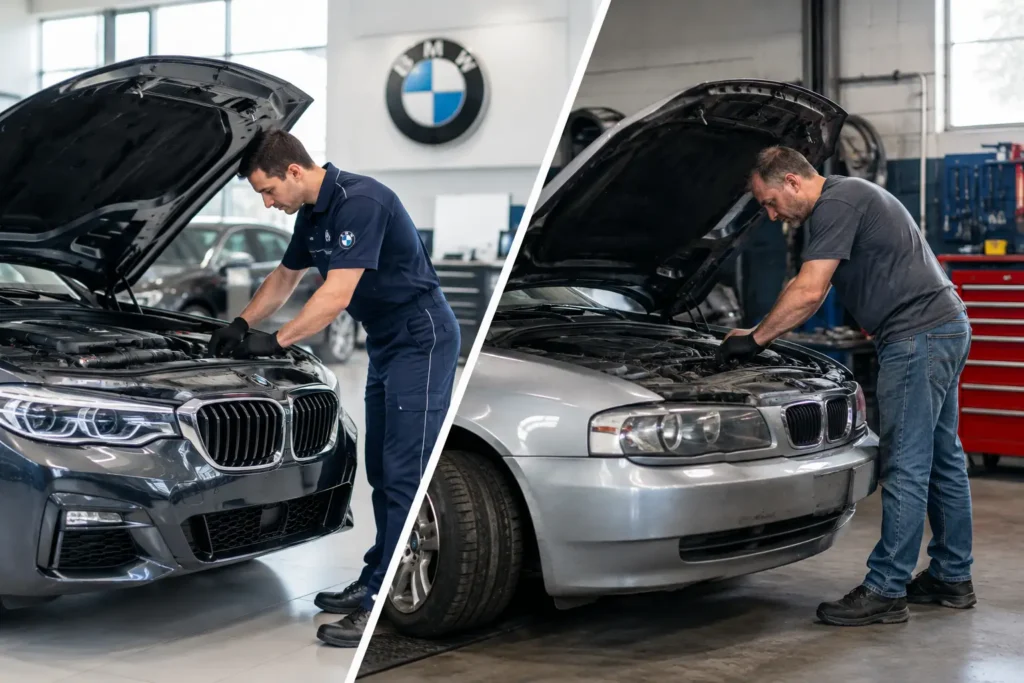
A BMW warning light rarely appears at a convenient time. Neither does an oil leak, rough shift, cooling fault, or iDrive issue. When it happens, the dealer versus independent BMW service decision becomes less about a logo on the building and more about who can diagnose the problem correctly, explain the repair clearly, and protect the car you enjoy driving.
For BMW owners, both options can be the right choice. A franchised dealer may be the practical route for a vehicle still covered by a manufacturer warranty, a recall campaign, or a software action that requires dealer-level access. A BMW specialist independent workshop can be a stronger fit for out-of-warranty maintenance, complex fault finding, repairs, and performance-focused work where direct technical attention and pricing transparency matter.
Dealer Versus Independent BMW Service: The Real Difference
The main distinction is not simply dealer quality versus independent quality. It is the business model, the technician relationship, and the scope of work each facility is designed to handle.
Dealerships operate within the manufacturer network. They are structured around BMW service processes, factory campaigns, warranty administration, and access to the latest manufacturer information. For a newer BMW with active warranty coverage, this can offer useful reassurance. If the repair is covered, the dealership is usually the first call. The same applies to safety recalls or manufacturer-issued service campaigns.
A specialist independent workshop is built around hands-on diagnosis, repair flexibility, and long-term ownership. The best independents invest in BMW-capable diagnostic systems, technical data, specialist tools, trained technicians, OEM-quality parts, and approved lubricants. They can service modern BMWs properly while giving owners a more direct conversation about priorities, options, and costs.
That difference matters when a car has a persistent electrical fault, an intermittent misfire, a cooling-system leak, or transmission behavior that does not produce an obvious answer. These repairs depend on methodical testing, experience with known BMW failure patterns, and the willingness to investigate beyond a basic fault-code scan.
When a BMW Dealer Makes Sense
A dealer is often the sensible choice during the factory warranty period. Warranty repairs need correct documentation and authorization, and a dealer can coordinate those processes. If BMW has issued a recall or a technical campaign for your VIN, the dealer can also confirm eligibility and complete the required work.
Dealer service may also appeal to owners who want every visit recorded within the manufacturer network. That can be useful for certain buyers when it is time to sell a newer, low-mileage vehicle. However, a complete independent service history with detailed invoices, correct parts, and documented maintenance is still valuable evidence that the car has been cared for properly.
There are situations where a dealer visit is worth considering even outside warranty. Software updates, coding requirements, and brand-specific programming procedures may be appropriate for the dealer, depending on the model and task. Ask a clear question before booking: does this repair require a manufacturer-only process, or can a BMW specialist carry it out with the right equipment and procedure?
The trade-off is often cost and personalization. Dealer labor rates, fixed menu pricing, and parts pricing can be higher. The service advisor may be managing many vehicles at once, which can make it harder to speak directly with the person diagnosing the car. That does not make dealer service poor. It simply may not be the most efficient or personal option for every repair.
Where an Independent BMW Specialist Adds Value
A capable independent BMW workshop should not rely on generic tools and guesswork. Modern BMWs are highly networked vehicles. The engine, transmission, chassis, battery-management system, comfort modules, driver-assistance features, and infotainment systems all communicate through complex electronic architecture. Accurate diagnosis requires equipment that can read live data, run guided tests, identify module communication faults, reset service functions, and verify repairs after the work is complete.
The advantage of a specialist independent is focus. Rather than replacing parts based only on a stored fault code, an experienced technician can test the likely cause. A low-voltage fault, for example, may relate to battery condition, charging performance, an intelligent battery sensor issue, or excessive parasitic draw. Replacing a battery without registration or without identifying the underlying problem can create another round of warnings and expense.
This approach is especially valuable on older BMWs and performance models. A specialist may see common N-series and B-series engine concerns, cooling-system faults, oil-filter-housing leaks, suspension wear, turbocharger issues, transfer-case behavior, and transmission complaints repeatedly. Pattern recognition does not replace testing, but it makes testing more efficient.
For owners in Dubai, heat also raises the importance of preventive care. Cooling systems, air-conditioning components, batteries, hoses, seals, and fluids work under demanding conditions. An independent workshop that understands the local operating environment can recommend maintenance based on the vehicle’s condition and use, not only the minimum interval on a service display.
Parts, Fluids, and the Details That Protect Your BMW
The question is not whether a workshop says it uses quality parts. Ask what it will actually fit to your vehicle.
BMW repairs can involve genuine BMW parts, OEM parts from the same original manufacturer, or aftermarket alternatives. Genuine and OEM components are often the preferred choice for critical systems such as engine components, cooling parts, sensors, braking components, and electronic modules. They are designed to meet the required specification and reduce uncertainty around fitment and durability.
There are cases where a reputable aftermarket part may be appropriate, particularly on an older vehicle or where an upgraded component solves a known weakness. The key is informed consent. You should know the brand of the part, its warranty terms, why it is being recommended, and how it compares with the original component.
Fluids deserve the same scrutiny. BMW engines, transmissions, differentials, and transfer cases have specific requirements. Using an approved oil grade and correct transmission or drivetrain fluid is not a minor detail. It affects lubrication, temperature control, shift quality, and component life. A workshop should be able to explain what fluid it is using and why it is suitable for your exact model.
Price Is Only Useful When the Scope Is Clear
An estimate that looks low can become expensive if it excludes diagnosis, required hardware, fluid, programming, or follow-up testing. A high estimate can also be difficult to evaluate if it does not separate urgent repairs from recommended future work.
A good independent workshop should provide a clear estimate before major work begins, explain the cause of the fault where possible, and contact you if further inspection changes the scope. This is particularly important for engine, transmission, electrical, and cooling repairs, where a visible symptom may have more than one contributing cause.
Ask whether the quote includes parts, labor, consumables, coding or adaptation procedures, and VAT where applicable. For maintenance, confirm exactly what is included: oil specification, filter brands, brake-fluid standard, inspection items, and whether service records will be updated.
The lowest-cost repair is not always the best value. Neither is the most expensive one. The best value is a correct repair using suitable parts, performed with the necessary diagnostic verification, so you are not paying twice for the same issue.
What to Ask Before Choosing a Workshop
Before you hand over the keys, ask practical questions. Does the workshop service your BMW generation and engine type regularly? Can it perform brand-specific diagnostics and programming when needed? Which parts and fluids will be used? Who will communicate the findings and authorize additional work?
Also ask about the repair warranty and documentation. A detailed invoice should show the work completed, parts installed, fluid specifications, and any recommendations. This supports future maintenance planning and gives the next owner confidence if you decide to sell.
For a modified BMW, the conversation needs to go further. Tuning, upgraded brakes, suspension changes, downpipes, intake modifications, and cooling upgrades can alter how the car behaves and how faults should be diagnosed. Choose a workshop that understands both factory systems and the effect of performance modifications, rather than treating every non-standard component as a problem by default.
Choose Capability, Not Just Convenience
There is no universal winner in dealer versus independent BMW service. Warranty and recall work may point you toward the dealer. Routine maintenance, complex repair work, honest diagnostics, and performance support may point you toward a proven specialist independent such as AM Motor Works.
The right workshop should make you feel informed rather than pressured. It should respect BMW engineering, use the right diagnostic process and components, and explain what your car needs now versus what can be planned for later. That is how a premium vehicle receives the level of care it was built to deserve.