
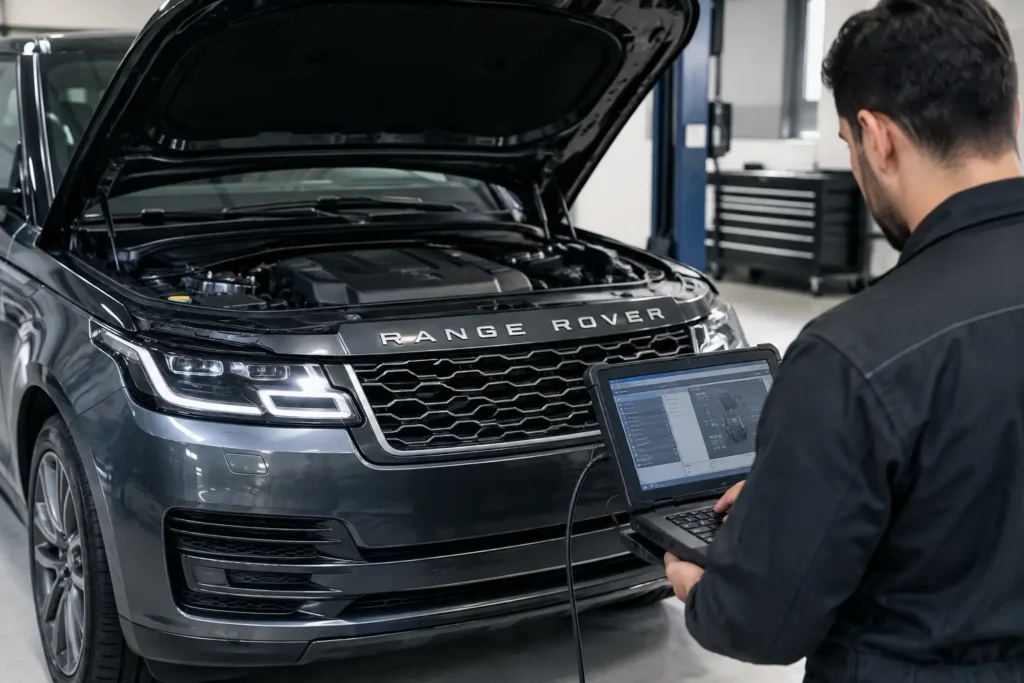
A Range Rover can display a warning light for a fault that is minor, intermittent, or genuinely urgent. The difference is rarely obvious from the dashboard alone. Proper Range Rover electrical diagnostics Dubai owners can rely on means finding the cause behind the message, not simply clearing it and hoping it stays away.
Modern Range Rovers are sophisticated vehicles with dozens of control modules managing the engine, transmission, suspension, braking, climate control, cameras, access systems, and infotainment. When one system loses power, data communication, or a valid sensor signal, the fault can appear in a completely different part of the vehicle. That is why electrical work on these vehicles needs a measured, brand-aware approach.
Why a Warning-Light Scan Is Not a Diagnosis
Reading fault codes is the starting point, not the repair. A code may identify a circuit, signal, or system that has detected an issue, but it does not automatically identify the failed component. For example, a low-voltage condition can create warnings for the suspension, parking sensors, steering, transmission, and infotainment at the same time. Replacing parts based on every stored code would be expensive and unlikely to solve the underlying problem.
An accurate diagnosis considers when the warning appeared, whether it returns after a cold start, how the vehicle behaves on the road, and what the live data shows. Technicians should also check the fault status. A historic code, an intermittent code, and a currently active code do not carry the same weight.
This matters particularly on a Range Rover that still drives normally. A vehicle may seem fine while a battery-management issue, water ingress, damaged wiring, or module communication fault develops in the background. Addressing it early can prevent a no-start situation or further damage to connected systems.
Range Rover Electrical Diagnostics in Dubai: What Changes
Dubai’s heat places real demand on electrical systems. High cabin temperatures, frequent air-conditioning use, and short journeys can all affect battery condition and charging behavior. A weak battery may start the vehicle in the morning yet drop voltage enough to trigger multiple alerts when electrical demand rises.
Dust, moisture, and previous repair work can also affect connectors, grounds, sensors, and harness routing. Water ingress is especially worth investigating after heavy rain, car washing, or a blocked drainage issue. Moisture inside a connector or module location can cause faults that appear and disappear without an obvious pattern.
The vehicle’s age, model, and equipment level also matter. A late-model Range Rover with advanced driver-assistance systems requires a different diagnostic path from an older vehicle with a conventional electronic parking brake or air-suspension warning. The right repair depends on the exact vehicle configuration and verified test results.
A Methodical Diagnostic Process
Reliable electrical fault finding begins with listening. Details such as a warning that appears only after parking overnight, a screen that resets during calls, or a tailgate that works intermittently can narrow the diagnostic direction quickly. A clear description of the concern saves time and helps reproduce the fault under the right conditions.
The next stage is a full vehicle health check using suitable diagnostic equipment. This allows the technician to review all relevant modules rather than focusing only on the warning shown on the instrument cluster. Fault codes, freeze-frame information, software status, live data, and network communication can reveal whether the issue is local to one component or shared across several systems.
Voltage and charging checks follow where appropriate. Battery state of health, battery state of charge, alternator output, voltage drop, and ground integrity are fundamental checks. They are not glamorous, but they are essential. A replacement battery may also need correct registration or configuration so the vehicle’s battery-management system can charge it properly.
When the evidence points to a circuit, the work becomes more physical. This may involve inspecting fuse boxes, connectors, wiring looms, sensors, actuators, and module power supplies. Technicians test before condemning a part. A failed height sensor and a broken wire leading to that sensor may produce similar codes, but only one requires a new component.
At AM Motor Works, this process is designed to give the owner a clear explanation before repairs proceed. If the diagnosis identifies a required part, the estimate should distinguish the confirmed repair from any recommended preventive work. That transparency is particularly valuable when a complex electrical concern involves several possible causes.
Common Range Rover Electrical Concerns
Some issues occur more often than others, although no symptom should be treated as a guaranteed diagnosis. Battery drain is a common example. A vehicle that needs frequent jump-starts may have an aging battery, an alternator concern, a module that remains awake after locking, an aftermarket accessory, or a fault in the charging system. Testing parasitic draw correctly takes time because modules need to enter sleep mode before current readings are meaningful.
Air-suspension warnings also deserve careful attention. The source could be a height sensor, compressor, valve block, air leak, wiring concern, calibration issue, or low system voltage. Clearing the warning without understanding its trigger risks leaving the vehicle unable to maintain the correct ride height.
Infotainment and camera faults can be equally frustrating. A black screen, repeated reboot, missing Bluetooth connection, reverse camera error, or failed navigation display may stem from software, a communication issue, a damaged connector, or a related control module. The repair path depends on the model and the evidence found during testing.
Other concerns that need specialist investigation include keyless-entry faults, power tailgate issues, parking sensor warnings, electronic parking brake alerts, climate-control faults, and intermittent no-start conditions. In each case, a parts-first approach can turn a manageable repair into a long and costly process.
Repair, Programming, or Further Testing?
Once the fault is confirmed, the solution may be straightforward, such as repairing a wire, replacing a sensor, fitting a correctly specified battery, or cleaning a compromised connector. Other cases require module programming, software updates, component calibration, or additional testing after a repair.
There are trade-offs. Replacing a component can be the right answer when testing proves it has failed, but it should not be used as a substitute for diagnosis. Likewise, lower-cost non-genuine electrical parts can create compatibility or durability concerns on a vehicle whose systems depend on precise signals and module communication. OEM-quality components and approved repair procedures are often the more sensible choice for long-term reliability.
When to Book an Electrical Inspection
Do not wait for a single warning to become several. Arrange an inspection if alerts return after being cleared, the vehicle cranks slowly, lights flicker, the screen restarts, suspension height changes unexpectedly, or functions such as cameras, locking, and climate control become intermittent. If a red warning appears, the vehicle enters reduced-power mode, or there is a burning smell, stop driving when safe and seek professional advice.
A Range Rover is engineered around connected systems, so its electrical faults deserve the same precision as its engine or transmission work. A careful diagnosis gives you something more useful than a cleared dashboard message: confidence that the repair addresses what actually caused it.