
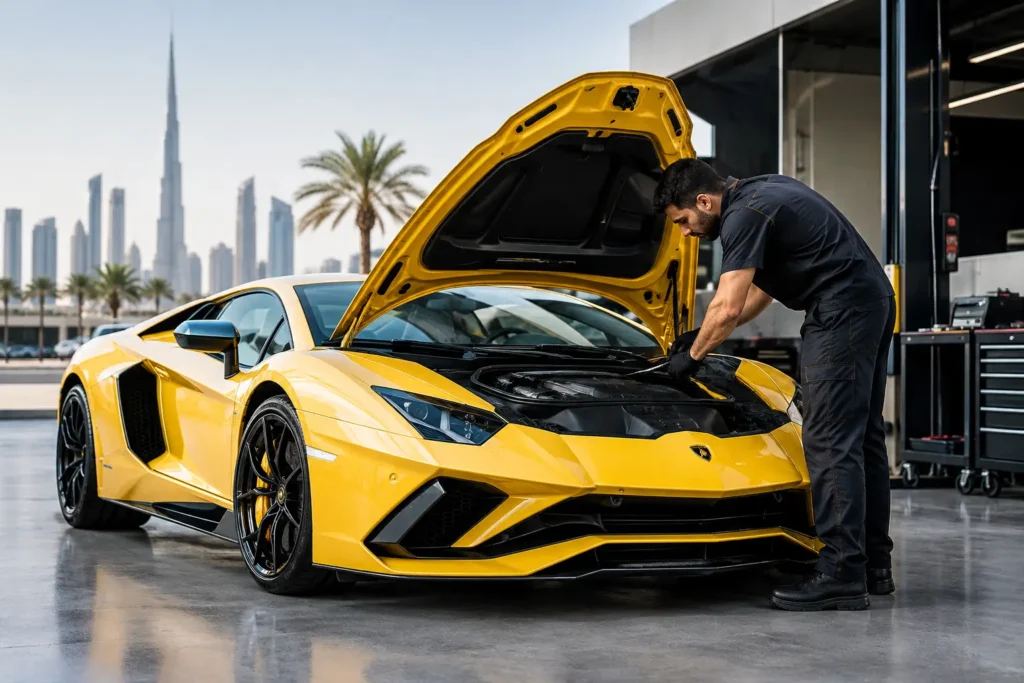
A Lamborghini can feel perfect right up to the point it does not. A slight change in shift quality, a warning message that appears only when hot, or a brake pedal that has lost its initial bite can be early signs that deserve attention. Lamborghini maintenance Dubai should account for more than mileage alone. High ambient temperatures, stop-and-go traffic, short trips, and long periods parked between drives all affect fluids, batteries, cooling systems, and electronics.
These cars are engineered to deliver extraordinary performance, but they rely on precise servicing to keep doing it. Whether you own a naturally aspirated V10 or V12 model, a turbocharged Urus, or a newer hybrid Lamborghini, the right workshop approach is based on accurate diagnostics, approved materials, and a clear understanding of how the vehicle is actually used.
Why Lamborghini Maintenance in Dubai Is Different
Dubai creates demanding operating conditions for any high-performance machine. Cooling systems work harder in extreme heat, air-conditioning is not a convenience but a critical daily system, and traffic can expose transmission and engine components to heat cycles that open-road driving may not. Fine dust and sand also place additional demands on cabin filters, air filters, seals, and radiator areas.
That does not mean every Lamborghini needs premature parts replacement. It does mean a service plan should be informed by inspection and vehicle condition, not simply a generic checklist. A low-mileage car that spends most of its time in a climate-controlled garage may need a different approach from one driven daily across the UAE. Both still need time-based attention to fluids, rubber components, batteries, and electronic systems.
An experienced specialist begins with the manufacturer’s recommended service schedule, then considers the car’s age, mileage, recent history, stored fault codes, and driving pattern. This protects the vehicle without creating unnecessary work.
The Core Services That Protect Performance
Engine oil, filters, and fluid condition
Oil service is fundamental, but it is not a one-size-fits-all job. Lamborghini engines require oil with the correct approval and viscosity for the specific model and engine. The wrong lubricant can affect protection at high temperatures, oil pressure behavior, and long-term component wear.
A proper oil service includes inspection for leaks, a check of fluid condition, replacement of the correct filter, and confirmation that service information is accurately reset. Depending on the vehicle, technicians should also assess coolant, brake fluid, transmission or clutch-related fluids, and differential fluids according to the applicable maintenance requirements.
Brake fluid deserves particular attention. Performance brakes generate significant heat, and fluid that has absorbed moisture can reduce pedal consistency and lower its resistance to boiling. The replacement interval is time-sensitive, even when the car has not covered many miles.
Brakes, tires, and suspension
Carbon-ceramic brakes can offer exceptional stopping performance and long service life, but visual appearance alone does not tell the whole story. Pads, rotors, sensors, calipers, brake lines, and brake fluid should be inspected as a system. A vibration under braking may be related to rotor condition, but it can also come from wheel balance, tire wear, suspension bushings, or incorrect wheel installation.
Tire condition is equally important. Wide, low-profile performance tires can age before their tread is fully worn, especially when a car is parked for extended periods or exposed to heat. Technicians should check tread depth, sidewall condition, manufacturing date, pressure, and uneven wear patterns. Uneven wear is often useful evidence of an alignment or suspension issue.
Lamborghini suspension systems are designed around precise geometry. A small alignment deviation can change steering feel, reduce tire life, and make the car less settled at speed. Alignment should be measured with equipment capable of handling the vehicle’s specifications, not estimated after a tire change.
Cooling and air-conditioning systems
A Lamborghini that runs at normal temperature on a brief evening drive may still have a marginal cooling issue under daytime load. Coolant level and condition, hoses, fans, radiators, water pumps, and thermostat operation all matter. Radiator areas can collect dust and debris, reducing airflow when the system needs it most.
Air-conditioning service also requires a diagnosis-first mindset. Weak cooling may be caused by refrigerant loss, a compressor issue, a pressure sensor, a cabin filter restriction, or an electrical fault. Simply adding refrigerant without identifying the cause can mask a leak and lead to another failure later. A proper repair includes leak testing where needed and use of the correct refrigerant and oil specification.
Diagnostics Are Not Just About Clearing a Warning Light
Modern Lamborghinis contain multiple control modules communicating across complex vehicle networks. A warning light is useful, but it is only the starting point. Reading a fault code without examining live data, freeze-frame information, module communication, and related system behavior can lead to parts being replaced on guesswork.
This is particularly relevant for intermittent concerns. A check-engine light that appears after a heat soak, a lift-system message that comes and goes, or a transmission alert during low-speed traffic may require a road test and targeted diagnostics rather than a quick scan. The objective is to identify the root cause, explain the findings clearly, and agree on the right repair before work begins.
Specialist diagnostic equipment, current technical information, and technicians familiar with high-performance European platforms make a meaningful difference here. Complex electrical and computer-system faults are often where an independent specialist can provide real value, especially when the process is transparent from inspection to final testing.
Do Not Ignore Battery and Electronics Health
A Lamborghini can have a healthy engine and still become unreliable if battery voltage is unstable. Modern vehicles continue to draw power when parked, and low voltage can trigger misleading fault messages or disrupt electronic functions. This is more likely when the vehicle is used infrequently.
Battery testing should assess more than whether the car starts. State of charge, charging performance, battery condition, and parasitic draw may all need evaluation. If the car will be parked for weeks at a time, an appropriate battery maintainer and regular operating routine can help avoid avoidable electrical issues. The exact approach depends on the model and its battery-management system.
Genuine Parts, OEM Parts, and the Right Decision
For critical maintenance items, the quality and compatibility of parts matter. Genuine Lamborghini parts are often the preferred choice, particularly where software coding, exact fitment, safety, or warranty considerations apply. High-quality OEM parts may also be appropriate in certain repairs, provided they meet the correct specification and are sourced responsibly.
The best decision is not always the most expensive one, nor is it the cheapest. It depends on the component, the age of the vehicle, intended use, and the owner’s priorities. Brake components, filters, belts, sensors, fluids, and suspension parts should never be selected solely on price. A transparent workshop should explain the options, identify what is recommended, and provide an estimate before proceeding.
When Maintenance Becomes an Opportunity to Improve the Car
Some owners want factory-correct care. Others want a sharper throttle response, a more engaging exhaust character, or carefully calibrated Stage 1 or Stage 2 performance upgrades. Both approaches can be valid, but modifications should begin with a mechanically healthy vehicle.
Before tuning, a specialist should confirm that there are no unresolved faults, leaks, cooling concerns, ignition issues, or transmission-related problems. Performance work adds load and heat, so it should be planned around the vehicle’s condition and the owner’s real driving goals. A well-executed upgrade is not about chasing a number. It is about preserving drivability, reliability, and control.
For owners seeking specialist Lamborghini maintenance in Dubai, AM Motor Works applies this same condition-first approach, combining modern diagnostics, approved lubricants, genuine or OEM-quality components, and direct communication throughout the repair process.
Signs Your Lamborghini Should Be Inspected Soon
Do not wait for a scheduled service if the car develops a new vibration, fluid leak, warning message, rough idle, delayed shift, unusual brake noise, reduced air-conditioning performance, or a change in steering response. These symptoms are not always serious, but prompt inspection usually gives you more repair options and can prevent a small issue from becoming an expensive one.
Keep service records, note when a symptom occurs, and mention any recent changes in driving behavior. Details such as whether the issue appears when cold, after parking, under braking, or only in heavy traffic can shorten diagnostic time considerably. Precision engineering rewards attentive ownership, and the right maintenance partner should make that ownership simpler, clearer, and more enjoyable.