
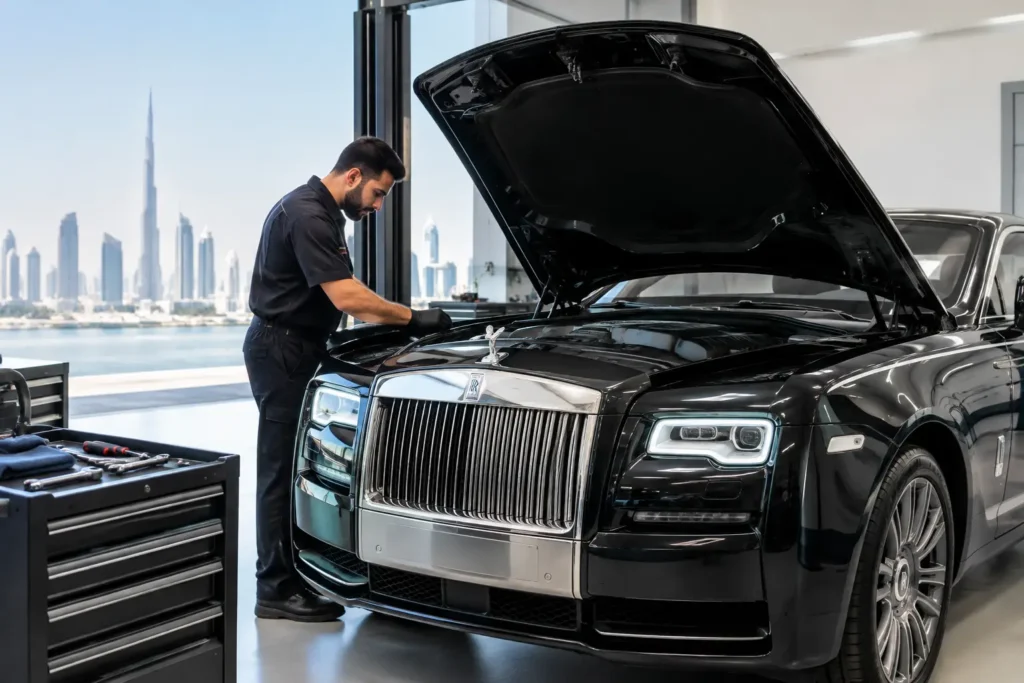
A warning light in a Rolls-Royce is rarely a simple matter of clearing a code and sending the car back on the road. These vehicles integrate refined mechanical engineering with highly networked electrical systems, air suspension, advanced climate control, and carefully calibrated comfort features. For owners seeking Rolls Royce repair Dubai, the priority should be accurate fault finding, suitable parts, and work that protects the way the vehicle drives and feels.
A Ghost, Wraith, Dawn, Cullinan, or Phantom deserves more than general luxury-car experience. The right workshop approaches every concern methodically, whether it is a minor service reminder, an intermittent electronic fault, a cooling issue, or a serious engine and transmission concern.
What Quality Rolls Royce Repair in Dubai Involves
Rolls-Royce ownership is built around effortless performance. That effortlessness depends on systems working together precisely. A rough idle, delayed gear engagement, suspension warning, weak air conditioning, or unusual noise can have several possible causes. Replacing parts before confirming the root cause can be expensive and may fail to resolve the actual issue.
Professional repair starts with a detailed inspection and brand-appropriate computer diagnostics. Modern Rolls-Royce models use multiple control modules that communicate across the vehicle. A stored fault code is useful evidence, but it is not always the diagnosis. Technicians must assess live data, wiring integrity, sensor behavior, battery condition, module communication, and the vehicle’s service history before recommending a repair.
This approach matters particularly with intermittent faults. A warning that appears only after extended driving, during high ambient temperatures, or when the suspension changes height may require a more involved inspection than a fault that is permanently present. Clear communication should explain what has been found, what testing is required, and why a specific repair is recommended.
Common Rolls-Royce Service and Repair Needs
Routine maintenance is the most reliable way to avoid preventable repairs. Oil, filters, brake fluid, coolant, transmission fluids, and other service items must be selected and replaced according to the vehicle’s requirements rather than treated as generic consumables. Approved lubricants and quality OEM or OEM-equivalent components help maintain the performance and durability expected from a Rolls-Royce.
Scheduled Maintenance and Fluid Service
Mileage alone does not tell the full story in Dubai. High temperatures, stop-and-go traffic, short trips, and extended idling can place additional demand on fluids, batteries, cooling systems, and air conditioning. A proper scheduled service includes a broader vehicle health check, not simply an oil change.
Technicians should inspect for fluid leaks, degraded hoses, cooling-system condition, brake wear, tire condition, battery charging performance, and fault codes that may not yet have triggered a dashboard warning. Catching a small coolant leak or weakening battery early can prevent a more disruptive repair later.
Brake Repair for Heavy Luxury Vehicles
Rolls-Royce vehicles are substantial machines with powerful braking systems designed to deliver smooth, controlled stopping. Brake pads and rotors should be assessed for remaining material, rotor condition, uneven wear, and any vibration or noise under braking. A brake warning message should be addressed promptly, but a pulsing brake pedal or steering-wheel vibration also warrants inspection even when no message is displayed.
The lowest-priced brake option is not necessarily the right one. Component quality, correct fitting, and proper bedding-in procedures all affect braking feel, noise, and service life. For a vehicle of this caliber, the objective is safe braking that remains quiet and refined.
Air Suspension and Ride Quality Concerns
The signature ride quality of a Rolls-Royce depends heavily on its suspension system. A vehicle sitting lower at one corner, taking too long to rise, displaying a suspension warning, or riding more harshly than usual may have an issue with an air spring, compressor, valve block, ride-height sensor, wiring, or control system.
These faults need careful diagnosis because the visible symptom can be misleading. For example, a weak compressor may be working overtime because of a minor air leak elsewhere. Replacing the compressor without checking the system thoroughly can leave the original leak unresolved. After repairs, calibration and verification are just as important as installing the part.
Engine, Transmission, and Cooling Diagnostics
Modern Rolls-Royce powertrains offer strong, quiet performance, but they are complex. Misfires, reduced power, overheating, oil leaks, rough running, smoke, unusual noises, or a transmission warning should never be ignored. Continuing to drive with an active powertrain issue can turn a controlled repair into more extensive mechanical work.
The repair process may involve a road test, scan-tool analysis, pressure testing, inspection of ignition and fuel systems, evaluation of boost-related components where applicable, and checks for coolant or oil contamination. Transmission symptoms also require nuance. A shift concern could stem from fluid condition, an adaptation issue, a control fault, driveline wear, or internal transmission damage. Proper testing prevents assumptions.
Electrical Faults Require More Than a Quick Scan
Luxury vehicles are highly dependent on stable voltage and reliable electrical communication. A weak or incorrectly managed battery can create a surprising range of symptoms, including warning messages, comfort-access issues, infotainment problems, sensor faults, and inconsistent operation of convenience features.
Battery replacement in a Rolls-Royce should therefore include testing of the charging system and consideration of battery registration or system adaptation where required. The same principle applies to faults involving cameras, parking sensors, lighting, soft-close doors, seat controls, infotainment, and climate functions. A scan tool can point technicians in the right direction, but electrical repair often requires hands-on circuit testing and an understanding of how the affected modules interact.
Choosing a Specialist Workshop
The best workshop is not necessarily the one that promises the fastest answer before inspecting the vehicle. Rolls-Royce repair can involve straightforward maintenance, but it can also demand advanced diagnostics, programming capability, careful dismantling, and access to the correct parts. Ask how the workshop confirms faults, what parts options are available, and whether the estimate distinguishes urgent work from items that can be monitored.
Transparency is especially valuable when repairs are complex. You should receive a clear explanation of the concern, the proposed work, parts choices, expected labor, and any additional findings before major work proceeds. Progress updates matter too, particularly if diagnostics uncover an issue that requires further approval.
At AM Motor Works, Rolls-Royce work is approached with the same focus applied to other sophisticated European and high-performance vehicles: experienced technicians, modern diagnostics, genuine OEM parts and approved lubricants, and direct communication throughout the repair process.
When to Book an Inspection
Do not wait for a minor concern to become an interruption to your schedule. Book an inspection if you notice warning messages, fluid spots beneath the vehicle, a change in ride height, brake noise or vibration, difficult starting, reduced cooling performance, rough running, shifting changes, or electrical features behaving inconsistently.
Some issues require immediate attention. Stop driving and arrange assistance if the engine temperature is rising, an oil-pressure warning appears, the brake pedal feels unsafe, there is a strong fuel smell, the vehicle has significant power loss, or a suspension fault affects stability or ground clearance. The right response depends on the warning and how the vehicle behaves, but caution is usually less costly than continuing to drive.
A Rolls-Royce should feel composed, quiet, and effortless. When it does not, a precise inspection is the practical first step toward restoring the ownership experience you expect.