
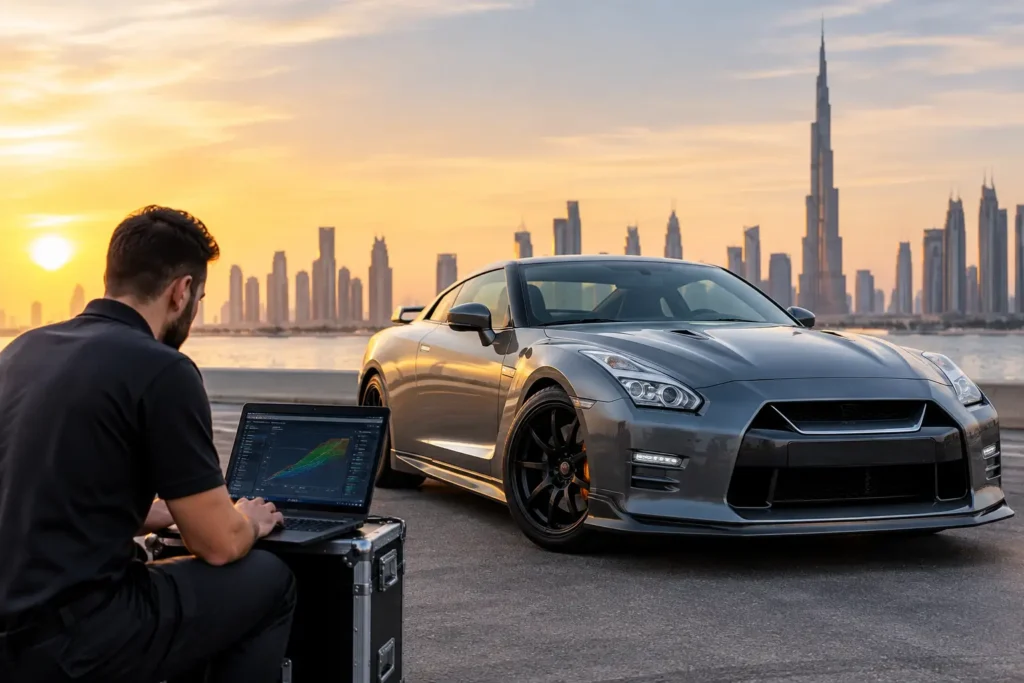
A modern performance car often has more capability in its engine control software than it delivers from the factory. That does not mean every vehicle should be tuned, but it explains why Stage 1 tuning Dubai is a popular upgrade for owners who want stronger mid-range response without replacing hard parts. Done properly, it is a calibration exercise guided by diagnostics, fuel quality, drivetrain condition, and the way the car will actually be used.
For a BMW turbo six, an Audi TFSI, a Mercedes-Benz AMG model, or a Porsche with forced induction, the difference can be noticeable before full throttle. Overtaking becomes more immediate, torque arrives with less hesitation, and the car can feel closer to the character its chassis suggests. The right question is not simply, “How much power can it make?” It is whether the car is healthy enough, the calibration is appropriate enough, and the owner’s expectations are realistic enough for the upgrade to make sense.
What Stage 1 Tuning Actually Changes
Stage 1 tuning is an adjustment to the engine control unit, commonly called the ECU. The ECU manages key operating strategies including boost pressure on turbocharged engines, fuel delivery, ignition timing, throttle response, torque limits, and, on many vehicles, how the engine communicates its permitted torque to the transmission.
Factory software is designed around a wide range of climates, fuel markets, driving styles, service intervals, and warranty considerations. A carefully developed Stage 1 file refines those parameters within sensible mechanical limits for a standard car. No downpipe, larger turbocharger, intercooler, or internal engine work is normally required.
That description matters because “Stage 1” is not a universal technical standard. One tuner may use the name for a restrained daily-driving calibration, while another may use it for a file that chases an impressive peak figure. The software’s source, the vehicle’s condition, the fuel it requires, and the diagnostic process behind the work matter far more than the stage label.
Naturally aspirated cars can also be calibrated, but expectations should be different. Without turbo boost to increase, gains are generally subtler and may be felt more in throttle mapping, torque delivery, and removal of conservative limiters than in dramatic horsepower changes. Turbocharged petrol and diesel vehicles usually offer the clearest Stage 1 gains.
Why Dubai Conditions Change the Conversation
Heat is part of the engineering equation. High ambient temperatures place greater demand on the cooling system, charge-air cooling, engine oil, transmission fluid, and air-conditioning system. A tune that feels fine during a short pull on a mild day may behave differently in heavy traffic or repeated acceleration during the hottest months.
This is why a responsible workshop looks beyond the software file. It checks for stored faults, reviews live data where appropriate, and considers the condition of components that influence safe performance. Boost leaks, tired ignition coils, worn spark plugs, marginal batteries, cooling-system issues, or transmission faults should be addressed before tuning. Software cannot repair a mechanical weakness. In some cases, it exposes one.
Fuel quality also matters. The calibration must match the fuel grade the owner will consistently use, not the best fuel available on an occasional visit. If a tune is designed around higher-octane fuel, using a lower grade can reduce performance and increase the likelihood of the ECU intervening to protect the engine.
For cars driven hard, regularly serviced fluids and a clean cooling system are not minor details. They are part of preserving the reliability that makes performance enjoyable in the first place.
The Pre-Tune Health Check Is Not Optional
A car that drives normally can still have faults that are invisible from the driver’s seat. Modern European vehicles are highly networked, and engine performance depends on accurate readings from sensors, actuators, fuel systems, cooling circuits, and control modules.
Before Stage 1 tuning, the workshop should identify the exact vehicle configuration and scan all relevant systems with proper diagnostic equipment. This establishes a baseline and helps uncover fault codes, misfires, boost-control irregularities, fuel-pressure deviations, intake leaks, or transmission-related issues. A warning light is not the only reason to investigate. Pending or intermittent faults can be just as relevant.
Service history should be part of the discussion. If spark plugs are due, oil service has been delayed, or a vehicle has an unresolved coolant loss, those jobs take priority. On higher-mileage examples, condition is more important than the badge or claimed stock power.
A good technician will also ask how the car is used. A daily commuter that spends long periods in city traffic needs a different approach from a weekend car used for spirited highway driving. The owner who wants smooth, predictable torque may be better served by a conservative calibration than someone focused on maximum output. More is not automatically better, especially when drivability and component life are the real priorities.
What You Can Expect Behind the Wheel
The most satisfying Stage 1 result is usually not a single dyno number. It is a car that responds more cleanly in the rev range used every day. Turbo engines often develop stronger low- and mid-range torque, making partial-throttle acceleration and passing maneuvers feel more confident. Throttle response can become sharper, though it should not become abrupt or difficult to modulate.
Actual gains depend on the engine, factory output, transmission, fuel, ambient temperature, and the calibration used. A turbocharged BMW, Audi, Mercedes-Benz, Volkswagen, or Porsche may show meaningful improvement, but published figures should be treated as estimates rather than promises. Dyno results vary by equipment and conditions, and peak numbers say little about consistency in hot weather.
Transmission behavior deserves attention as well. Many modern automatic and dual-clutch gearboxes monitor calculated engine torque closely. On some applications, transmission calibration may be worth considering to align shift behavior and torque management with the engine tune. That is not required for every vehicle, and it should never be treated as an automatic add-on. The correct route depends on the gearbox, software version, vehicle condition, and the intended torque level.
The Trade-Offs Owners Should Understand
Stage 1 tuning can be a well-judged upgrade, but it is not consequence-free. Higher cylinder pressures and torque loads create more demand on engine, transmission, cooling, and drivetrain components. On a properly maintained vehicle with a sensible calibration, that demand may be manageable. On a neglected vehicle, it may accelerate an existing problem.
Warranty status is another practical consideration. Manufacturers and dealers may be able to identify altered software, and tuning can affect warranty coverage. Owners should also check applicable insurance, registration, and road-use requirements before modifying their vehicle. A professional workshop should be direct about these considerations rather than presenting tuning as risk-free.
There is also a difference between a car that produces a strong dyno pull and a car that remains civilized for daily use. Excessive low-rpm torque can make a rear-wheel-drive car harder to manage and may add unnecessary stress to the drivetrain. Aggressive throttle mapping can feel exciting for ten minutes and tiring for months. The best calibration is one that complements the vehicle, not one that overwhelms it.
Choosing a Workshop for Stage 1 Tuning in Dubai
The software is only one part of the service. Choose a workshop that understands the specific platform, has the tools to diagnose it correctly, and is willing to decline the work if the vehicle is not ready. Clear answers matter: what software is being installed, what fuel it is designed for, what checks are performed beforehand, and what support is available if an issue appears afterward.
AM Motor Works approaches performance upgrades with the same discipline used for complex repair and diagnostics. For luxury and high-performance vehicles, the goal is not a generic file loaded in minutes. It is a calibration decision supported by vehicle-specific knowledge, modern diagnostics, honest advice, and a clear view of the maintenance required afterward.
Be cautious of offers based solely on the largest claimed power increase or the lowest price. An inexpensive tune becomes costly if it masks faults, uses unsuitable parameters, or leaves the owner without a proper explanation of what changed. Transparent estimates and straightforward technical communication are signs that the workshop values the car beyond the initial appointment.
Maintaining a Tuned Vehicle
After tuning, maintenance should become more deliberate, not more complicated. Follow appropriate oil and fluid service intervals, use the specified fuel grade, and do not ignore new warning lights, rough running, fluid leaks, or changes in shift quality. If the car is driven enthusiastically, discuss shorter service intervals and inspect ignition, cooling, brakes, and tires with the added performance in mind.
Give the engine time to reach operating temperature before demanding full power, particularly after cold starts. After sustained hard driving, allow temperatures to stabilize rather than immediately shutting the vehicle down. These are simple habits, but they support the components working hardest under increased load.
A Stage 1 tune should make a great car feel more alive without making ownership feel uncertain. Start with an honest health check, choose calibration over hype, and let the vehicle’s condition set the limits. That is how a performance upgrade remains a pleasure long after the first drive.