
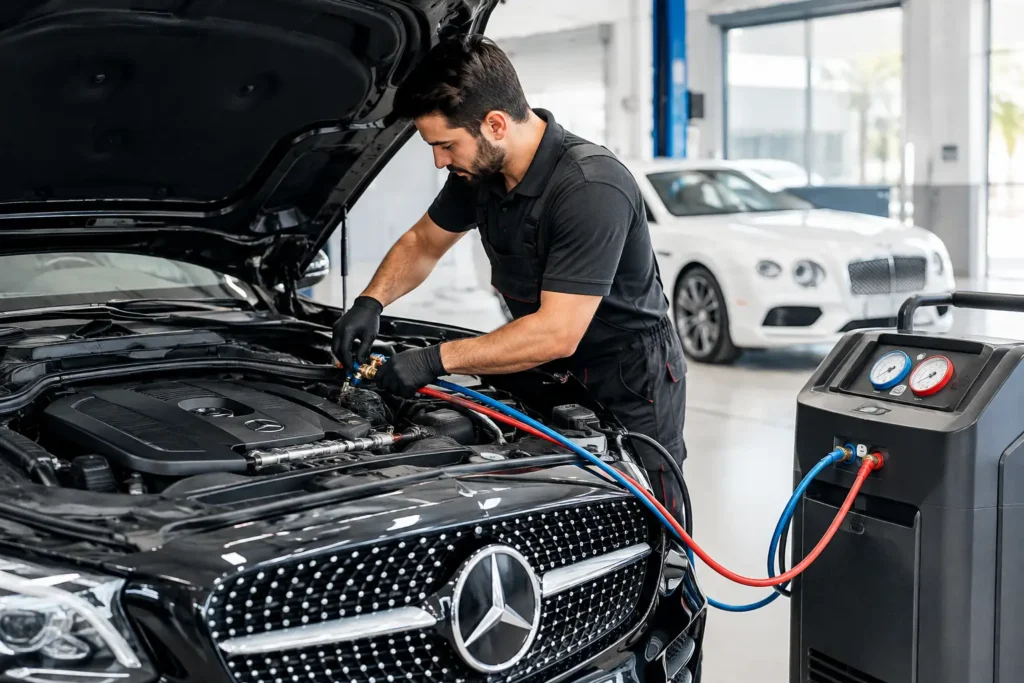
A luxury car’s air conditioning system is not simply a comfort feature in Dubai. It protects concentration in traffic, keeps cabin electronics from excessive heat, and makes every journey more manageable when outside temperatures climb. When cooling becomes weak, uneven, noisy, or unpredictable, car air conditioning repair Dubai should begin with accurate diagnosis rather than a quick refrigerant top-up.
Modern BMW, MINI, Mercedes-Benz, Audi, Porsche, Jaguar Land Rover, Lamborghini, and Rolls-Royce climate systems are closely tied to sensors, control modules, valves, fans, and cabin-air management. A cold vent one day and warm air the next can point to a leak, but it can also be caused by an electrical fault, a failing compressor control valve, or incorrect data from a temperature sensor. Finding the real cause protects both the vehicle and the repair budget.
When Your AC Needs Attention
The most obvious warning sign is air that no longer feels properly cold. However, reduced cooling is not the only clue. If the system takes much longer than usual to cool the cabin, performs poorly at idle, or blows cold from one side and warm from the other, it deserves professional inspection.
Unusual sounds matter too. A clicking sound behind the dashboard may relate to a blend-door actuator, while rattling or grinding from the engine bay can indicate compressor or pulley trouble. A musty odor at start-up often comes from moisture and microbial buildup around the evaporator or cabin filter. It may not mean a mechanical failure, but it should be addressed before air quality suffers.
Watch for visible signs as well. Water dripping beneath a parked car after using the AC is usually normal condensate. Greasy residue around AC lines, fittings, or the compressor is not. Refrigerant oil can escape alongside refrigerant, leaving evidence of a leak that needs to be repaired before the system is recharged.
Why Luxury-Car AC Faults Need Proper Diagnosis
Premium vehicles use sophisticated climate-control systems designed for quiet operation, fast cabin cooling, and precise temperature zones. Those benefits also mean a generic approach can miss the fault. Recharging a system without leak testing may restore cool air briefly, only for the refrigerant to escape again. Overcharging it can be equally harmful, affecting cooling performance and compressor operation.
A proper assessment starts with system pressure readings, vent-temperature testing, visual inspection, and computer diagnostics where applicable. Technicians should check stored fault codes, sensor readings, compressor commands, cooling-fan operation, and the requested versus actual refrigerant pressure. On many late-model European cars, the diagnostic process is as important as the mechanical work.
For example, a BMW or MINI may reduce compressor output when it detects a fault in the pressure circuit or engine cooling system. A Mercedes-Benz with multi-zone climate control may develop a flap motor or actuator issue that affects only one area of the cabin. On a Porsche or Audi, a control-module fault can mimic a refrigerant problem. The symptom may be similar, but the repair is not.
Common Car Air Conditioning Repair Dubai Services
The right repair depends on what testing reveals. Refrigerant leaks are among the most common issues in hot climates. They can develop at seals, hose connections, condensers, evaporators, service ports, or compressor components. A damaged condenser is especially common because it sits at the front of the vehicle and is exposed to road debris.
If a leak is found, the failed component or seal should be repaired or replaced first. The system is then evacuated to remove air and moisture, checked for its ability to hold vacuum, and recharged with the manufacturer-specified refrigerant quantity and compressor oil. This sequence is essential. Moisture inside an AC system can cause corrosion, restrict refrigerant flow, and shorten component life.
Compressor repairs require particular care. The compressor circulates refrigerant and oil throughout the system, so internal failure can spread debris. In those cases, simply fitting a new compressor may not be enough. The technician may need to inspect the receiver drier or accumulator, expansion valve, lines, and condenser, then flush or replace affected parts as required. This is where correct diagnosis prevents a costly repeat failure.
Electrical issues are another regular source of AC complaints. Faulty pressure sensors, relays, wiring, cooling fans, control valves, and climate-control modules can all stop the system from operating as intended. Computer diagnostics can narrow the search, but live testing remains necessary. A fault code identifies a circuit or condition, not always the failed part itself.
Heat, Traffic, and High-Performance Vehicles
Dubai traffic places a demanding load on air conditioning systems. At highway speed, airflow through the condenser helps remove heat efficiently. At idle or in slow traffic, the electric cooling fan must do much more of that work. If the fan is weak, intermittent, or not receiving the correct command, cabin cooling may be acceptable while moving but noticeably worse when stopped.
High-performance and exotic vehicles add further considerations. Tightly packaged engine bays create substantial heat, while larger radiators, oil coolers, and intercoolers compete for airflow at the front of the car. An AC issue can sometimes be connected to broader engine-cooling performance. If coolant temperature is rising, fans are running constantly, or a vehicle is reporting thermal-management warnings, both systems should be evaluated together.
The same principle applies after modifications. Performance tuning, cooling upgrades, or front-end repairs do not automatically cause AC faults, but altered airflow, disturbed wiring, or incorrectly refitted components can affect operation. A specialist workshop should assess the vehicle as a complete system, not treat the AC as an isolated circuit.
What a Quality AC Service Should Include
An AC service is more than adding refrigerant. The workshop should first confirm the system’s condition and identify whether a repair is necessary. If refrigerant is low, there is usually a reason. Refrigerant does not get used up like engine oil.
A thorough service may include recovering and measuring existing refrigerant, pressure and performance testing, leak detection, evacuation, and recharge to the correct factory specification. It can also include inspection of the cabin filter, evaporator drainage, belt and pulley condition, condenser condition, and cooling-fan performance. For vehicles with odors or reduced airflow, evaporator cleaning and a fresh cabin filter can make a meaningful difference.
OEM-quality components and approved refrigerant oil matter, particularly on European and performance vehicles. The wrong oil or an incorrect refrigerant charge can affect lubrication and cooling efficiency. Lower-cost parts may be appropriate in some situations, but critical components such as compressors, valves, and sensors should be selected with long-term reliability in mind.
How to Avoid Bigger AC Repairs
No maintenance routine can prevent every leak or component failure, but regular use helps. Running the AC periodically, even during cooler months, circulates oil through the system and helps keep seals lubricated. Replacing a blocked cabin air filter supports airflow and reduces strain on the blower motor.
It also pays to investigate weak cooling early. A system that is merely underperforming may need a straightforward repair. Continuing to operate it with low refrigerant, a failing fan, or compressor noise can turn a manageable issue into a more extensive job. If cooling drops suddenly after a front-end impact or recent repair, book an inspection rather than repeatedly recharging the system.
For owners who expect dealership-level technical care without unnecessary guesswork, AM Motor Works approaches climate-control faults with brand-aware diagnostics, transparent estimates, and clear explanations of what the vehicle actually needs. The goal is not just colder air from the vents, but dependable operation when the weather puts every component under pressure.
If your cabin is taking longer to cool, one side is blowing warm, or the compressor has become noisy, address it before the next high-temperature drive. A precise inspection now can preserve comfort, protect expensive AC components, and keep the car performing as its engineers intended.